
Entry Door Thresholds and Energy Loss in Sharon, MA: Diagnosing Problems and Knowing When to Replace
Is your Sharon entry door drafty in the winter, hard to open, or letting rain track into the foyer? Homeowners often notice these symptoms first at the threshold—the small part of the door system that meets the exterior floor and bears a lot of wear. This article explains what entry door thresholds do, how different threshold types and materials affect energy and water performance, simple checks you can perform safely, repair options that often restore comfort, and the signs that a full door replacement is the more appropriate step. We focus on practical decision guidance for Sharon, MA homeowners asking: “Is my drafty entry door fixable or does it need replacement?” and point to the relevant services and resources a contractor like Boss Services, Inc. would use when an on-site evaluation is needed.
Table of contents
- Why thresholds matter for energy, comfort, and durability
- Common threshold types and how they perform
- Signs your threshold or sill is failing
- Simple diagnostics homeowners can do safely
- Weatherstripping and seal-upgrades that often fix drafts
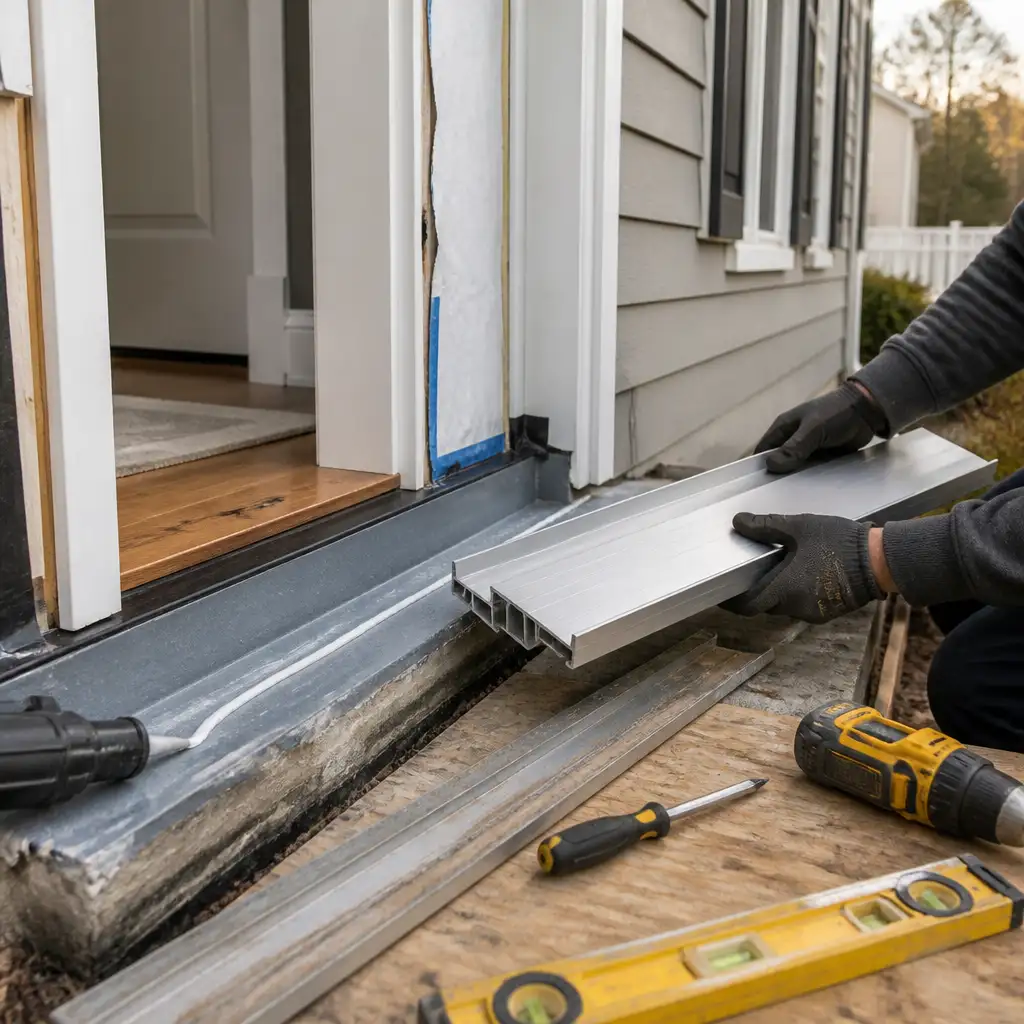
- Sill and threshold repair options a contractor may use
- Thermal breaks and material considerations
- When to consider full door replacement
- Project sequencing and related work to plan for
- Questions to ask your contractor during an estimate
- Maintenance and a short seasonal checklist
- FAQ
Why thresholds matter for energy, comfort, and durability
The threshold is the component installed at the base of an exterior door rough opening. It may be a continuous metal or composite extrusion, a wood sill, or an adjustable mechanism that compresses against a gasket on the door bottom. Though small, thresholds play several essential roles:
- Air seal: a properly seated threshold plus an intact bottom seal prevents cold air infiltration and helps maintain indoor comfort.
- Water management: thresholds and sill pans direct water away from the interior and into exterior drainage planes; a failed threshold lets water contact floor materials and framing.
- Thermal performance: materials and design affect thermal bridging; metal thresholds without thermal breaks can conduct cold to the interior floor plane.
- Accessibility and operation: thresholds set the door sweep height and play a part in whether a door sticks, rubs, or swings freely.
- Wear surface: thresholds take foot traffic and the contact of footwear, pet claws, and seasonal debris; after years they often show mechanical wear first.
In Sharon’s seasonal climate—cold winters, thaw cycles, and spring rains—small water or air leaks at the threshold are common contributors to comfort complaints and to long-term rot or flooring damage if left unattended. Because the threshold ties together the exterior cladding, the door frame, and the interior finish, diagnosing a drafty or sticking entry door requires looking at all these interfaces and how they were flashed and sealed.
Common threshold types and how they perform
Understanding the basic threshold types helps you recognize what you have and what can be expected from repairs. Not every threshold in a Sharon home is the same—age, door material, and previous maintenance affect performance.
Aluminum and metal thresholds
Aluminum thresholds are common because they’re durable and easy to factory-form. They may be extruded to include a recess for a compressible gasket or a replaceable vinyl sweep. The downside is that aluminum is a good thermal conductor—without a thermal break or foam isolation it can pass cold into the interior floor. Modern designs often include a low‑conductivity insert, but older solid metal thresholds commonly predate that detail.
Adjustable thresholds
These thresholds allow the installer to raise or lower the threshold to tighten the seal against a door bottom gasket. They’re useful for correcting a sagging door or compensating for settling. If well maintained they can extend the service life of the door assembly, and they make on-site tweaks simpler than removing and reinstalling a fixed sill.
Wood sills and composite sills
Traditional wood sills (often pressure-treated) are still found in older homes. They can be durable when protected by paint and flashing, but once they rot the seal fails and the supporting jambs may soon follow. Composite sills and polymer-clad sills resist rot and are less prone to dimensional change from moisture, but they must still be integrated with proper sill pans and flashing.
Low-profile (ADA-style) and flush thresholds
Low-profile thresholds allow easier passage and can be important for accessible entries. These designs trade a higher curb for a thinner weather barrier, so they rely on excellent door sweeps, tight jamb fit, and often a separate sill pan or integral flashing detail to manage water. In heavy exposure conditions a flush threshold without good drainage is riskier.
Sill pans and integral flashing
A sill pan is a formed or pre-formed membrane installed under the threshold to catch and redirect incidental water out to the exterior. When properly integrated with housewrap and jamb flashing, it’s the defense against water tracking into subfloor framing. Many threshold problems trace to missing or failed sill pans rather than to the visible threshold piece itself.
Thermally broken thresholds
Some modern thresholds incorporate a non-conductive material between exterior and interior metal parts. This thermal break reduces conductive heat (or cold) transfer and improves the effective thermal performance of the door system. For Sharon homeowners concerned primarily about drafts and cold floors, this design can make a measurable difference in comfort after a replacement or upgrade.
Signs your threshold or sill is failing
Not every problem is obvious. Below are observable signs that indicate you should investigate the threshold or surrounding details more closely.
Drafts and cold floors
Feeling a focused stream of cold air at the base of the door, especially on windy days, usually means the threshold seal or door sweep is compromised. Cold along the interior flooring near the door can also be a thermal bridging symptom from a conductive threshold.
Sticking or rubbing during operation
If your door drags on the sill when closing or sticks in certain weather, there may be swelling from moisture, a settled foundation, or a warped sill. Sticking that varies with humidity or temperature points to material change rather than a mechanical hinge adjustment alone.
Visible rot, soft wood, or corroded metal
Rot at the sill, soft flooring near the threshold, or crumbling painted trim are clear red flags for replacement of affected materials. Corroded thresholds—especially at fastener locations—can indicate salt or standing moisture exposure and reduced capacity for an effective seal.
Pools or staining on the interior flooring
Water marks, cupping of wood floors, or carpet discoloration within the threshold zone suggest that the sill pan or exterior flashing has failed. These symptoms usually require more than a weatherstrip refresh; the water path must be corrected.
Excessive gap visible at the threshold
If you can see daylight under the door from outside, or if a thin strip of daylight is visible at the interior, there is an air path that needs sealing or physical adjustment. Small gaps may accept a new sweep; larger gaps may require threshold replacement or jamb repairs.
Simple diagnostics homeowners can do safely
A few low-risk, non-invasive checks can tell you whether the problem might be an easy fix or a candidate for professional evaluation. Avoid any task that requires dismantling structural parts, roof access, or roof‑height ladders.
Visual check around the threshold
Look for obvious gaps, softened wood, deteriorated sealant, or rusted screws. Inspect under the door sweep or foot-scrape area—accumulated debris can prevent a sweep from closing fully. Note any discoloration of interior floors or trim that suggests moisture migration.
Draft test with a candle or smoke
With safety in mind, close the door and hold a small candle or a smoke stick (incense) near the edges and bottom. Watch the flame or smoke: steady movement indicates an air path. Do not leave candles unattended; use a wind-safe small candle and keep flammable materials away.
Weather variation observation
Check whether the draft or sticking happens primarily in cold, hot, or rainy conditions. If sticking is worse on wet days, moisture swelling or failed sill pans are likely. If drafts are worst on windy days, air sealing is the primary problem.
Check the sweep and threshold fasteners
Inspect the door bottom sweep for brittle rubber, missing fasteners, or gaps. Tighten loose screws on the threshold visible from above if they’re easily reached. Do not force fasteners that are fragile or rusted; that can create more damage.
Look for exterior flashing and integration
From a safe ground-level view, check how the exterior cladding and door trim meet the threshold. Is there an obvious step in the siding or a missing drip edge? Missing or poor flashing is a common root cause of water-related threshold failure.
Weatherstripping and seal upgrades that often fix drafts
In many cases, a properly selected weatherstrip or sweep restores comfort quickly and economically. Matching the right product to the door construction matters.
Door sweeps and replacement sweeps
Door sweeps are the first-line fix for air infiltration at the bottom edge. They come in surface-applied aluminum housings with replaceable rubber inserts, or as full-width vinyl or brush strips. For older wooden doors you may have a threshold-mounted sweep. Replace an obviously worn sweep before trying more invasive work.
Threshold gaskets and compression seals
Many thresholds have integral compressible gaskets that press against the door bottom. If the gasket is flattened or cracked, it can often be replaced without changing the threshold. Adjustable thresholds allow tightening the gasket compression to restore the seal.
Perimeter weatherstripping
Door jamb weatherstripping—bulb seals, V-strips, or compression strips—works with a healthy threshold to prevent wind-driven air from bypassing the bottom seal. Look for consistent contact along the latch and hinge side, not just the bottom edge.
Threshold-mounted door sweeps and retrofits
When the door bottom is irregular or the floor plane is uneven, a threshold-mounted sweep or a saddle that raises the floor interface can be used to create a uniform contact surface. These retrofits are more intrusive but can be very effective without a full door replacement.
Sill and threshold repair options a contractor may use
When weatherstripping alone won’t solve the problem, a trained installer will evaluate the sill and threshold attachment, the sill pan, and the jambs. The right repair depends on the observed defects and on how the door assembly ties into the exterior cladding.
Replace the threshold only
If the frame and jamb are sound and the sill beneath the threshold is not rotted, replacing the threshold with a new, thermally improved model is a common and cost-effective repair. New thresholds often include replaceable gaskets and integrated thermal breaks and can be installed in a single day.
Install or repair a sill pan
Where water infiltration is evident, installing a pre-formed polymer sill pan or forming a custom pan with flashing membrane redirects water out of the rough opening. This repair is best done with the threshold removed, and it requires careful flashing integration with the housewrap and exterior trim.
Adjust or replace an adjustable threshold
Adjustable thresholds are serviceable: the installer measures the compression, adjusts the screws, and may replace compression inserts. If the threshold is corroded, the mechanism can usually be replaced while keeping the existing jamb intact.
Partial sill repair or epoxy-sistering
When localized rot exists, it is sometimes practical to remove only the damaged portion of the sill, treat the adjacent wood, and install a replacement sill piece or composite insert. This is a contained repair that reduces scope and preserves existing finishes where possible.
Planing or trimming the door bottom
Sticking due to a swollen door may be resolved by planing a thin amount from the underside of the door or adjusting hinges. This must be done carefully to maintain the factory weatherstrip locations and the door’s finish integrity. It’s often combined with threshold adjustment.
Full sill and jamb replacement
When rot extends into the jambs or framing, the professional solution is to remove the door and replace the sill and any compromised jambs and framing. This restores structural integrity and allows correct installation of a thermal break threshold and sill pan. It is more invasive but sometimes the only long-term remedy.
Thermal breaks and material considerations
For Sharon homeowners focused on energy and comfort, material selection for the threshold matters. Discuss these considerations with your contractor during an estimate.
Why thermal breaks help
A thermal break is a low-conductivity layer between the exterior metal and the interior metal or floor. It reduces heat flow by interrupting the conductive path. In cold weather, a thermally broken threshold lowers the cold-transfer into the interior and reduces the cold floor sensation directly in front of the door.
Material durability
Aluminum is durable but conductive; composite sills resist rot and require less maintenance; wood can be attractive and repairable but requires careful flashing and maintenance. Consider expected foot traffic, route of exposure to salt or de-icing chemicals, and how visible the threshold will be from inside when selecting a replacement material.
Finish and interior flooring connection
Threshold height must coordinate with interior flooring, exterior porch or landing materials, and any accessibility needs. When changing threshold height or material, plan for transition trims or floor adjustments. A professional will confirm the final detail matches your interior finish and any stair or deck edges outside the door.
When to consider full door replacement
Threshold and weatherstrip repairs are often sufficient, but there are clear situations where full door replacement is the wiser long-term option rather than repeated component repairs.
Widespread rot or structural decay
If rot extends beyond the sill into the door frame, into the jambs, or into subfloor framing, a full removal and replacement of the door assembly plus sill and associated framing is typically necessary. Partial fixes in these cases are temporary and can lead to repeated service calls.
Compromised security or operation
Doors with multiple performance failures—loose hardware, unrepairable warped stiles, failing cores in wooden doors, or security vulnerabilities—are candidates for replacement. A new door with better hardware and factory-applied weatherstripping can restore both function and safety.
Extensive or chronic moisture intrusion
When periodic leaks have led to recurring interior damage, it’s worth evaluating whether the door and threshold assembly, the surrounding trim, and the exterior flashing should be replaced together. Replacing only the threshold without correcting flashing and housewrap integration can result in continued problems.
Significant thermal or comfort goals
If a homeowner plans to address other efficiency upgrades—new windows, improved insulation, or a conditioned entry space—replacing the door with a thermally efficient model (with a thermally broken threshold and integrated sill pan) can be part of a comprehensive plan. Coordinate these upgrades to avoid rework.
Project sequencing and related work to plan for
Door and threshold work often affects adjacent trades. Thinking through sequence helps reduce callbacks and patchwork.
Coordinate with siding or trim work
Replacing a sill pan or removing the jamb often requires trimming or replacing exterior cladding details. If your home will need siding or trim adjustments, schedule the threshold work so the siding trade can integrate flashing and trim rather than doing separate minor touch-ups later. See our gallery of window and door projects for examples of coordinated work.
Flooring transitions
Threshold height changes can affect interior flooring transitions—shoe molding, thresholds, or small ramp strips may be needed. Inform your contractor about recent interior flooring changes so they can preserve or plan for the visible finish details.
Decks, porches, and exterior landings
Work on an exterior threshold may require temporary removal of porch boards or the adjustment of a landing to create a proper drainage pitch away from the house. If the exterior deck or porch is due for replacement, consider coordinating the two projects so decks and doors integrate properly.
Questions to ask your contractor during an estimate
When a contractor from Boss Services, Inc. or another qualified installer visits your Sharon home, asking focused questions helps you compare proposals.
- Can you show me the root cause you see (water path, rot, missing sill pan, thermal bridging) and explain repair options?
- Will the work include a sill pan or flashing integration with the existing housewrap and cladding?
- If you recommend threshold replacement only, will the jambs and framing be inspected for hidden damage?
- What threshold material and thermal details do you recommend for my entry exposure and interior finish?
- How will you handle interior flooring transitions and exterior landing integration?
- Do you provide any workmanship documentation for the door and sill work, and can you show typical completed examples in your gallery?
These questions focus the estimate on the cause, the durability of the proposed solution, and the coordination required with adjoining materials. Boss Services, Inc. has a windows and doors contractor service page where homeowners can see the kinds of door and threshold work we coordinate; the page gives a sense of the company’s approach to sealing, flashing, and finish carpentry.
Maintenance and a short seasonal checklist
Small seasonal maintenance reduces the chance that a simple threshold issue grows into a full replacement. Below is a practical checklist you or a hired professional can perform.
- Clear debris from the threshold and the exterior landing—dirt and leaves hold moisture against materials.
- Inspect and replace torn or brittle door sweeps and bottom gaskets.
- Check and retighten visible threshold fasteners; replace rusted screws if accessible.
- Examine sealant joints and repaint or re-caulk where paint has cracked or sealant has failed.
- Test for drafts with a smoke stick or candle when the wind is blowing to identify sealing priority areas.
- On rainy days, check for staining on interior floors—early detection avoids structural rot.
FAQ
Q: Can I fix a drafty door myself with new weatherstripping?
A: For small gaps and worn sweeps, new weatherstripping or a replacement sweep is often an effective do-it-yourself fix. Make sure the product you choose fits the door’s profile and that the bottom of the door and threshold are clean and free of debris. If the draft persists after a sweep replacement, or if you find rot or evidence of water intrusion, have a qualified installer evaluate the sill and flashing to avoid hidden damage.
Q: How long does a typical threshold last?
A: Lifespan varies by material, exposure, and maintenance. Aluminum thresholds are durable but can corrode in salty or wet settings; wood sills can last decades if well flashed and kept dry, but trapped moisture shortens that life. Regular inspection and prompt weatherstrip replacement extend the life of any threshold.
Q: If I replace the threshold, will I need to replace the door too?
A: Not necessarily. If the door, jambs, and hardware are structurally sound and the problem is limited to the threshold, a threshold replacement combined with new weatherstripping frequently restores performance. Full door replacement is recommended when the door is warped, the jambs are rotted, the hardware is failing, or if you want a door with improved thermal performance matched to a thermally broken threshold.
Have questions about your home’s exterior? Boss Services, Inc. can help you consider the next step. Contact our team, call 508-297-0635, or email bossservicesinc@comcast.net.